


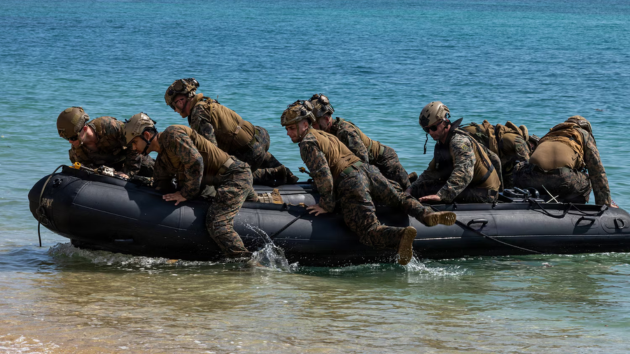
(WASHINGTON) -- The Pentagon's decision to send the 31st Marine Expeditionary Unit, a 2,200-troop force, to the Middle East is fueling new speculation about whether the conflict with Iran could involve U.S. ground troops, a step that would mark a dramatic escalation and potentially push the already unpopular war into a far more dangerous phase.
It could take up to two weeks, or the end of March, before the unit is in place and its presence unlikely to significantly shift the dynamics of the war on its own, experts say. A Marine Expeditionary Unit (MEU) can deliver an initial surge of troops quickly, but seizing and holding key terrain, or sustaining a prolonged fight, would almost certainly require a far larger ground force.
Experts say the MEU would likely be used to conduct raids across the Iranian shoreline to gain a foothold in areas across the crucial oil shipping waterway, the Strait of Hormuz, which has emerged as a contested point of the conflict.
A Quinnipiac University poll from earlier this month showed 74% of registered voters opposed sending U.S. ground troops into Iran while 20% supported it.
Asked Tuesday if he was afraid of the Iranian regime's assertion that U.S. boots on the ground "will be another Vietnam," President Donald Trump replied, "No, I'm not afraid. I'm really not afraid of anything."
Sailing from the Pacific, it will likely take up to two weeks for Marines to be in place in the Middle East, and it is not yet clear what those troops would be used for. The unit operates as a self-contained, sea-based force -- essentially a floating hub capable of launching troops, aircraft and equipment without relying on nearby bases or infrastructure.
Reopening the Strait of Hormuz would unlock a waterway through which 20% of the globe's oil supply transits each day. Its closure has seen gas prices soar and markets roiled. Trump has referenced shorelines from which the Iranians can attack vessels transiting the waterway.
"Now we are pounding that area, that coast, as you know, left side," Trump said Monday. "We're pounding it like really pounding it hard."
According to Michael Eisenstadt, a senior fellow at the Washington Institute, the MEU could take part in land-based "raids" on targets along that coast.
"There's a number of missions where you can conceivably see a MEU playing a role, either unilaterally or kind of in conjunction with maybe the deployment of larger Army units," said Eisenstadt, who believes the deployment of the MEU was likely related to the strait.
Iranian fortifications along the coast that could "interfere with convoy operations," Eisenstadt said, could be U.S. targets. Top military leaders have said they've explored the potential uses of convoys, or warship escorts, to facilitate the safe passage of commercial shipping through the strait.
Raiding parties could target missile storage bunkers that are hardened and difficult for U.S. warplanes to destroy from the air.
The idea would be to "clear out the shore and then use air power to prevent them from returning once you've cleared out those areas," Eisenstadt said.
Such an operation would not by itself create conditions for smooth sailing in the strait, experts told ABC News.
"My concern is that it takes so little to disrupt the shipping industry, Eisenstadt said. "If there's a small, you know, kind of a small residual [Iranian] capability, it could still potentially be very disruptive."
The 2,200 Marines in the MEU would limit any operation longer than a raid, which have pre-planned withdrawals. To get on land, these types of Marine units primarily seize footholds by riding small watercraft onto beaches or by helicopter insertion.
"Normally in an amphibious assault, you have all sorts of Navy landing craft behind you to sustain the force ashore. There's none of that. There's none of that logistical tail that would allow them to remain ashore," said retired Marine Col. Steve Ganyard, an ABC News contributor.
Leaving strategic waters in the Pacific
The 31st Marine Expeditionary Unit is primarily based in Japan, where it routinely trains with the Japanese Self-Defense Forces on skills in high demand across the Pacific, including rapidly seizing small islands. Earlier this month, it took part in a major annual exercise that featured amphibious assault drills, marksmanship training and operations focused on capturing hostile terrain, according to the Defense Department.
Their removal from the region removes one of the primary ground combat elements in the Pacific, which could respond to a crisis with China or North Korea. Other significant combat elements in the region include the Army's 2nd Infantry Division, stationed to bolster South Korea's frontline against Pyongyang, as well as the Army's 25th Infantry Division in Hawaii and the 11th Airborne Division in Alaska.
"That leaves a ground combat and amphibious capability gap in the region," Carlton Haelig, an expert in military operations and fellow at the Center for New American Security, said.
The 11th Marine Expeditionary Unit, based out of Camp Pendleton, California, is preparing to deploy to the Pacific, according to Pentagon imagery.
Copyright © 2026, ABC Audio. All rights reserved.
 'Boom' heard in Ohio may have been from meteor, National Weather Service says
 Bank of America reaches proposed, non-binding settlement in suit alleging it aided Jeffrey Epstein's crimes
 Jury finds Utah mom Kouri Richins guilty of fatally poisoning husband with fentanyl
 Retired Air Force major general missing for weeks: What we know about his mysterious disappearance
 Afghan who died in ICE custody worked with US forces in Afghanistan, advocacy group says